WWW.BOLGOV.NET
|
Radiometer,
dosimeter, radiation control.
|
Design of search radiometer-dosimeter.
|
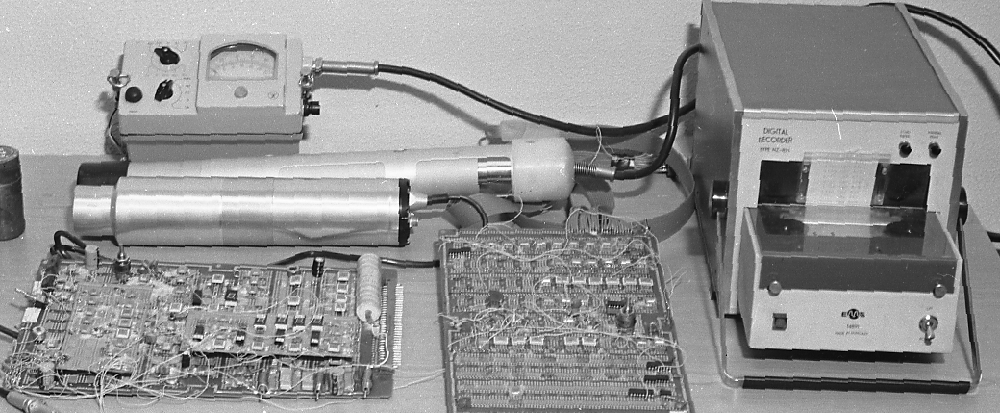
1985 photo
|
Once,
while working in a library that used to be called the State Public
Scientific and Technical Library (GPNTB) and was on Kuznetsky Bridge,
in the heart of Moscow, looking through various electronics journals,
such as, for example, Radio Electronics Australia, Electronics (USA),
Radio Electronics and others, I came across an article by engineers at
the Los Alamos Laboratory, which described a device for detecting and
searching for radioactive materials. It is worth noting that in those
years, in those journals there were many articles describing various
devices for recording radiation from radioactive materials.
|
|
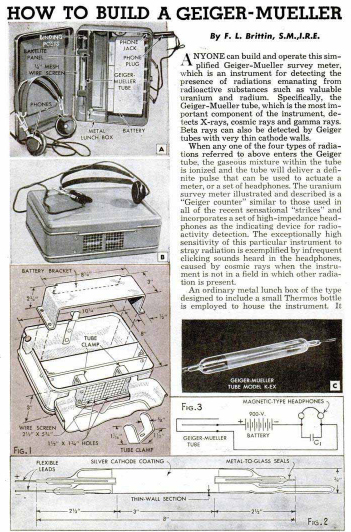
These
traditions began in 1949 with the magazine Popular Mechanics. Even then
in this journal was given a description of the device for searching for
uranium for independent construction. In the United States and Canada,
uranium fever began. The U.S. government has announced that anyone who
finds uranium deposits will be rewarded in dollars. And following the
good rules of the gold rush, people rushed to look for these deposits
from the border with Mexico in the south, to the northern coast of
Canada. This fever gave impetus to the development and production of
various devices, which are better called the "indicator of
radioactivity".
|
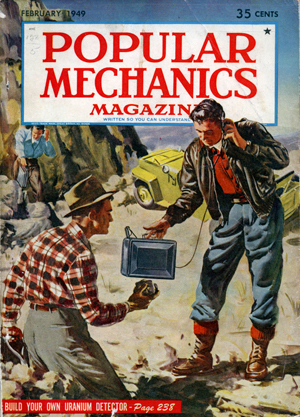
Visit the website of this magazine.
It's archived since 1902. Very interesting to read.
|
|
|
I translated a
lot of articles. Well, for example, an article from the magazine
"Radioelectronics" about the device Radarlet, the article can be read
here. The article also provides basic schemes.
Back to the Los Alamos Laboratory article. The article touched upon
several issues that were considered in great detail. Well, first of
all, what to look for. Which should be a search criterion. It is
impossible to create a device without preparing a technical task. The
search algorithm and the algorithm of the search device were also
described in detail. There's also a block diagram.
|
Прибор
Radarlet
(из журнала "Радиоэлектроника")
|
At the time, I
had a question about my diploma. I graduated from the Moscow Institute
of Radio Engineering, Electronics and Automation. The road to higher
education was long and winding. It started at the Moscow Institute of
Electronic Engineering, where I studied for almost 2 years, and I was
expelled for inability to pass the exam in mathematics. All other
subjects were grades 4 and 5. I didn't pass math. And I was expelled.
And then I entered the Moscow Institute of Radio Engineering,
Electronics and Automation. As I later realized, everyone who was
expelled from other Moscow institutes of electronic profile gathered
here. I got this impression after meeting my new classmates.
|
|
But here I had
problems with mathematics. I still have dreams that I have not yet
graduated from college, and I have to pass math. And so - there is an
interesting situation - you already need to go to the diploma, and
mathematics is not passed. Do what? A wonderful comrade Pavel Elterman
studied with me in the group. Thank you very much Pasha for your help.
Turned to him. He said, "No problem." In short, through the Zavkhoz,
through Zavgar or anyone else in a certain interlude, and through the
history of the Communist Party, I finally passed the mathematics. The
CPSU was the only benefit. And now you can enjoy the upcoming diploma
vacation.
|
|
And before
that, I had to decide on the subject of the diploma. And the thesis
vacation lasted 4 months - I had it for the following months: May,
June, September, October. One month I could go hiking, or go traveling,
which I loved. Not for nothing, my boss said that when Bolgov goes on a
business trip, then skis first appear from the plane, then a backpack,
and only then Bolgov himself. What was the purest truth was confirmed
by documentary photos (see photo on the right) and reports from the
field. The system worked smoothly, without failure. Reports :)
And in those student days, during the graduation leave, they paid a
salary of 100 rubles a month, and all four months you could not show up
for work. A wonderful event - this graduate leave. All pleasures in one
bottle: travel, creative work on a diploma, and salary. Let's move on
to the subject of diploma.
|
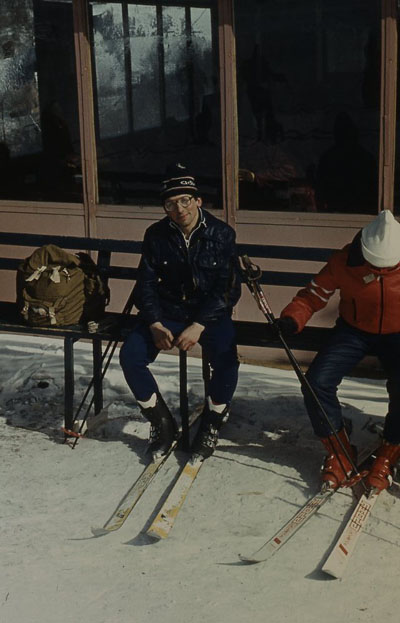
Uzhoksky perval in the Carpathians. Here in the
morning from Uzhgorod left the "snow train", and at 5 p.m. returned
back to Uzhgorod. This expedition and alpine ski is still stored in the
garage.
|
I had two
directions:
1. Device for archaeologists to search for metal during archaeological
excavations. For two seasons, using study holidays, I worked on an
archaeological expedition in Turkmenistan, in Geok-Tepe. The town of
Geok-Tepe is known for the fact that under General Skobelev there was a
battle of Turkmen tribes with Russian troops, which ended with the
victory of the Russians. And I worked on the expedition as a
cook-earther. In the morning, the cook, and in the morning he mowed the
tithe of grass to the local feudal lord Kokali, who was in charge of
the chicken farm, for which he gave me chicken after mowing, and in the
evening, after the heat subsided, a mole rat. The first time he gave me
a chicken, no skin. They take their feathers off with their skins.
And when you work with a shovel, there are cases that antique metal
objects were damaged by this heaviest shovel. Among them were copper
and gold coins of the Achaemenid and Susanid powers.
|
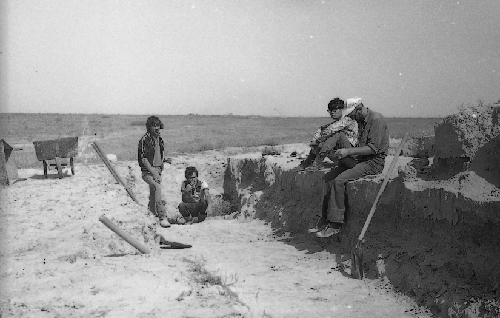
This is our archaeological unit. 1979 May month.
Geok-Tepe. On the right, historian Valera Yailenko tunes the WEF radio
to Voice of America.
|
|
|
And
archaeologists just needed a metal detector. And it was possible to
take a metal detector for the topic of the diploma, especially since
friends
From the technical service of customs (see the photo on the right) gave
me a diagram of a manual imported metal detector, which was used at the
time at customs.
In the old notebook, this scheme even survived. I put it in the picture
below. Figure 1. |
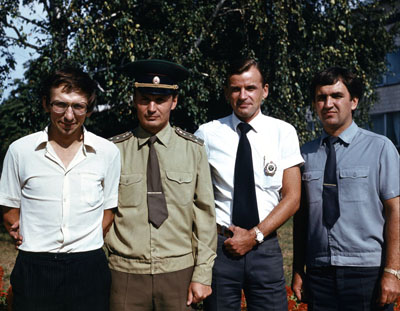
My friends are customs officers and border
guards from Boryspil Airport,
Not far from Kiev. 1984. Then it was the USSR.
In a white shirt with a tie - Deputy head of customs Kozin Vladimir,
and next to him the head of the technical
Customs service Nikolai Kondakov.
|
| But the
archaeological expeditions were three years ago and somehow forgotten.
And I stopped at the search radiometer, especially since there was
almost a ready-made technical circuit solution (see the article by Los
Alamos Laboratory). |
|
And then I
studied at the radio design faculty of MIREA, and my specialty was
called "Engineer-designer-technologist of radio electronic equipment."
Of course, this topic did not arise from scratch. |
|
Здесь пропуск информации. Позже будет добавлена.
|
|
| I already said
that at that time I studied at the Moscow Institute of Radio
Engineering, Electronics and Automation. And my fellow students worked
mainly in military units, sharagas, mailboxes. Of course, most of these
enterprises are no longer in Moscow, others are noticeably shrunk. So
there were no problems with parts, electronic components, wiring in
those years, almost 40 years ago. As you know, there was nothing on
sale, but everyone had it. For example, an excellent thin silver-plated
mounting wire was brought to me by my mountain hiking comrade with the
Central Design Bureau of Mechanical Engineering in Reutovo. Oleg, thank
you! By the way, there was also an excellent green technical capron,
which was used by tourists for backpacks and other equipment, and from
which I sewed a case for a radiometer, which I issued for testing.
|
|
By the way, a
small piece of that capron is still left and it will be necessary to
sew a case from it for the historical radiometer that needs to be
reproduced for the radiometer museum. In the United States, there is a
museum of dosimeters and radiometers. Why not build a small museum of
instruments? Many of them no longer exist in nature, but they can be
reproduced.
Let's go back to the graduation. In between trips to orienteering
competitions and various tourist events, I started mounting an
electrical circuit. |
|
Здесь описание из 1980 года.
|
|
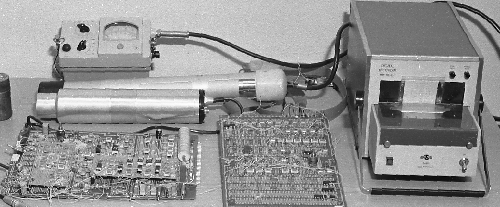
| The first
option, shown in photo #1 on the right, I assembled on layout boards,
mostly using 564 series chips. Well, just in the "sharags" on the "mailboxes" chips were only this
series, military, in a metal ceramic case. Now they are expensive, and
then they were worth nothing. My job was organized by Alexander
Vladimirovich (for which I am very grateful). He always gave me all
sorts of support. He created such conditions for me to work on the
thesis project that I could assemble a circuit of the device and
immediately test it in real conditions. It's very important. And
immediately get the necessary recommendations for changing the
algorithm of the device. |
Фото
№1
. |
Back to photo
number 1. In fact, what is presented in the photo is a working layout,
capable of working. In the background, the SRP-68, which I used as a
model, calibrated my circuit.
I would like to repeat the course of history. Like it really was. |
|
| Therefore,
photo No. 2 is a mock-up, which I collected according to the same
scheme (and since the entire archive has disappeared over the years), I
had to draw up a basic electrical circuit from memory. In the
background, the SRP-88 geological exploration device (a later
modification of the SRP-68) and the BDEG detection blog. |
|
After assembly
and checking its operability, the scheme was revised, the number of
parts was significantly reduced. And I put the whole circuit together
on two boards, put it in a slide box, put it in a green-colored hood,
with a handle, to carry over the shoulder.
This radiometer was equipped with an earpiece. And also there was a
system for wireless communication between the device and the headphone.
That was a huge advance in those days. The system worked reliably and
without failure. I borrowed the wireless schematic solution from the
Austrians, from the system for finding people in avalanches. I went to
the mountains at the time, and this topic was relevant to me. Remember,
it was 1985. |
Второй макет прибора, дипломного проекта.
|
I gave this
search radiometer for trial operation. There was no ID for the device.
It was a private matter, so to speak, a personal initiative. At work,
no one even knew about my creative experiences and research. Moreover,
I did not appear at work for almost six months, or even more, and even
then only for a salary. Graduate leave!
Experimental operation showed excellent results. The chiefs of the
technical service wrote me a great positive review, saying only that
they could not print. It was all unofficial. It was 1985. Perestroika
only loomed somewhere in the distance. |
|
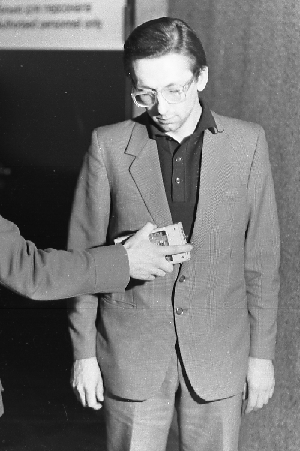
A couple of years later, already working in a
technical school and friends with the Institute of introscopy, I
repeated this scheme, but already in a pretty building, well suited to
the dosimeter. This option, though no longer working (it took almost 33
years), I found and now it is presented in photo No. 4, and the device
itself in action in photo No. 5.
|
Фото
№ 5
|
Let's continue
our work.
After the layout (photo No. 2), we collect a valid sample using
discrete elements, almost as in 1984. It is necessary to transfer it to
the programmer, who on its basis will program a special microprocessor
with an indicator. This working sample is presented in photo No. 7. |
|
After the
programmer has prepared the software, collect the search radiometer
dosimeter in a case conveniently adapted for this purpose. Looking at
photo number 8.
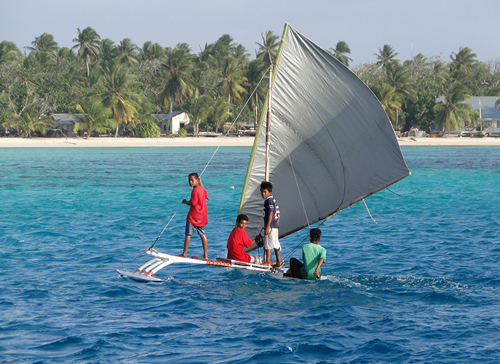
Since our goal is to create a search radiometer dosimeter to work in
harsh conditions of both tropical climate (Bikini Atoll) and winter
cold, our search radiometer should have absolute tightness - it should
not have any connectors, and external control handles (tumblers,
switches, etc.). This task is completely solvable. |
|
| The device will
be equipped with wireless charging batteries and a wireless
transmission system, including the transmission of an audio signal to
the headphone to localize radioactive materials. |
|
|
|
|
|
|
|
|
|
|
|
|
|
E-mail:
vladimirbolgov@gmail.com
|
|
|
|
|
|
|
|