|
They
sent me on a business trip to the Danube and Prut. The Danube is a
great European river, almost like the Volga in Russia, connecting
several European countries. Look at the map of Europe, where the Danube
River is highlighted. By the way, my grandfather, Philip Golovlev,
according to my grandmother, could very accurately draw a map of Europe
by hand on a blank sheet of paper. Why? You ask.
|
|
|
After
the Revolution of 1905, in which his grandfather took an active part on
the side of the Bolsheviks, he had to hide from the tsarist guard, that
is, “make legs” from the Russian Empire. And his way passed through
European countries to the shores of the Atlantic Ocean, and then on a
steamer to America, to the United States, the North American United
States, as the United States was then called. As he traveled to the
Atlantic through Europe, his grandfather visited various European
countries.
|
|
|
He
studied the geography of Europe. He returned to Russia when in 1913 in
the Russian Empire was a political amnesty, on the occasion of the
300th anniversary of the house of Romanov.
|
|
And he brought
tomato seeds from Texas (my grandmother told me) that my grandmother
grew in Nikolsky-Arkhangelsk, where we lived on line 13. I still
remember my grandmother putting the biggest tomatoes on the windowsill,
and then picking out and drying the seeds and putting them in bags.
You can talk about grandparents for a long time. It's next time.
|
|
|
But
back to the Danube and Prut. Let's see which countries the Danube flows
through. The Danube takes its source in the Black Forest Mountains in
Germany. The Danube flows through the territory or is the border of ten
states: Germany, Austria, Slovakia, Hungary, Croatia, Serbia, Bulgaria,
Romania, Ukraine and Moldova; passes through such capitals of Central
and South-Eastern Europe as Vienna, Bratislava, Budapest and Belgrade.
|
|
| And
now I have the opportunity to visit the banks of the Great Danube. We
went the following way. From Moscow to Odessa by plane. Then from the
sea station of Odessa, the hydrofoil ship "Comet". We were greeted at
the airport by Yuri Mikhailovich and a major from Izmail. After lunch,
we board the Comet and sit down. There is also a 3-liter jar with
excellent red Izmail wine. And under wine we began to move along the
Black Sea towards the mouth of the Danube. The first 3-liter jar,
replaced by the second, and we still go through the Black Sea. Swimming
is going great. As Ishmael approached, it began to fade. Magnificent
sunset. |
|
| I
went to get my photo camera and started taking pictures. The captain of
the ship comes up to me and says that there is a border zone and it is
forbidden to take photos. Nearby, a major from Ishmael says to the
captain, pointing at me, "He can." There is a cruise ship from Vienna.
And European tourists, from their high decks, take pictures with their
cameras to the right and left. Why can they, but not us Soviets? Why?
It's clear though. This is so that from the photos, I could not
determine the place of escape from the Soviet Union. This is crazy.
That's a story that comes to mind. We were told the story of a Jew who
dreamed of leaving the Soviet Union. So, in terrible weather, he was
able to swim across the Prut and reach Bucharest. And on a tip from the
USSR, he was taken by local Chekists in a synagogue in Bucharest. Back
in the USSR. Remember when there was such a country? He was taken in
handcuffs to the place where he left for Romania. |
|
|
So
to speak, an investigative experiment. And this time he escaped, only
inside the USSR. And after some time, he was taken to Hasan Kuli, on
the border with Iran on the Caspian Sea. In the Soviet Union there was
a ban on photographing in the border zone. But not only that. It was
1984. Goodwill games. Well, this is when instead of the Olympics in Los
Angeles, in defiance of the West for boycotting the Moscow Olympics-80,
for the introduction of Soviet troops in Afghanistan, Moscow hosted the
Goodwill Games. My friend and I went to basketball. The start of the
match was delayed. We decided to have a snack with bagels, which the
saleswoman sold next to the entrance in a beautiful Russian national
costume.
|
|
| Volodya
got in line, and I stepped aside and took out the camera. I was just
about to take a picture of a man running up to me, who was carrying
bagel boxes from the car to the saleswoman, and started shouting that
it was impossible to take pictures, it was a product, and he was going
to call the KGB. What's so bad about it that I would photograph my mate
buying bagels? It was 1984. Perestroika only loomed somewhere ahead.
After that, 4 years passed, and in Yerevan airport, during the rescue operation after the
earthquake, it did not occur to anyone to ban the work of even
foreign operators, and just take photos. |
|
|
Хabout
12 years ago, in 2012, I once flew from Domodedovo (I don’t like this
airport) to Verona, and while waiting for a plane to board, I walked
around the airport. In the cafe, I decided to take a picture. The
saleswoman started shouting that it was impossible to take pictures and
she was going to call the police. I had to give in. Otherwise, instead
of boarding a plane, they'd have to explain themselves to the police
station.
|
|
|
I
walked away from the Danube. Already in the dark we moor in the river
port of Ishmael. We're staying at a local hotel. The next day we work
in the river port, make sketches, write the survey report. After lunch,
a tour of the city and the fortress, which was taken by A.V. Suvorov.
|
|
Reading
Wikipedia:
“The fortress had an important military importance, as evidenced by the
sieges of the fortress during the Russian-Turkish wars of the
eighteenth century.
One of the most important wars between the Russian and Ottoman Empires
was the war of 1768-1774. During this war, on August 5 (July 26, old
style), 1770, Russian troops under the command of Nikolai Repnin took
the fortress of Izmail. However, at the end of the war in 1774,
according to the terms of the Kuchuk-Kainarji Peace Treaty, the
fortress was returned to Turkey.
|
|
After 13 years,
a new Russian-Turkish war began. In 1789 Repnin again tried to take the
city, but the assault ended in failure. On December 11 (22), 1790, the
reinforced fortress, considered impregnable by that time, was stormed
by Alexander Suvorov. In 1791, under the Treaty of Jassy, the city was
again returned to the Ottoman Empire.
Wow, now I get it.
|
|
And the next
day, in the morning, after breakfast, on PAZIK (this is a bus of the
PAZ brand, Pavlovsk Automobile Plant) they drove towards the glorious
town of Leushena, along the Romanian-Soviet border. On the way, we
stopped at one of the "friends of the border guards." From the basement
was brought dry white wine in a foggy large kettle. This kettle of wine
still stands in my eyes. It's drooling. The wine was great. It's not in
the store, you don't know what's in it. As the border guards say, the
local population is the best guard. If there is a stranger in the area,
they will immediately let you know.
|
|
|
Keep
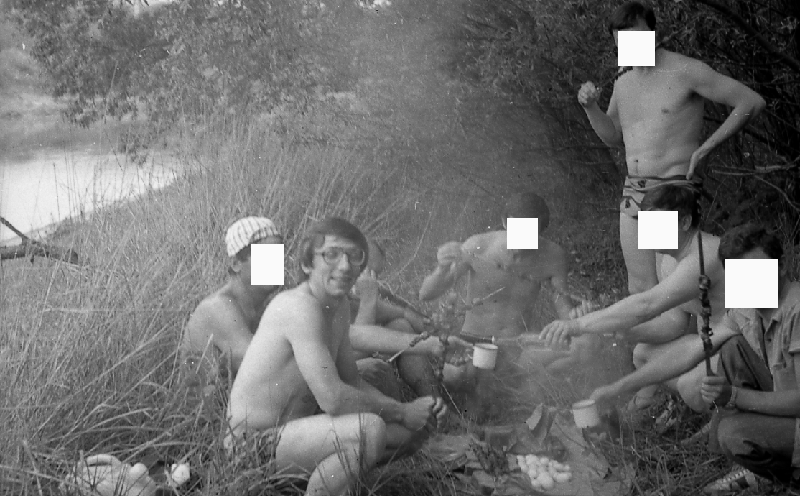
going. Here comes the village of Leushena. Almost home. Two years ago,
I did my first installation here. We were greeted very warmly. In the
morning, inspection of the object, coordination of the location of the
equipment, drawing up sketches, and after lunch, a cultural program.
And since there are two attractions in Leusheny: a winery and fishing
on the Prut River, the cultural program loomed by itself: barbecue and
fishing on the banks of the Prut border river.
|
|
|
The
event went really well. After a couple of glasses of good red wine (at
that time I was engaged in sports - amateur orienteering) - and tried
to exclude vodka from his assortment, Slava offered to swim in Romania.
Let's go. The current in Prut was decent, even too decent. We sailed to
the Romanian coast and back. And on the shore, Major Vladimir
Vasilyevich, the representative of the staff, waved his hand and tried
to say: "Bulgov, come back!" This was my second border violation, but
without any consequences, as everything was under control. It blew us
300-500 meters. Nice rest! Then, with a net for fishing, we walked
along the shore.
|
|
|
The
next day we went to the city of Ungheni. And then to Chernivtsi. To be
continued.
|
|
|
|
|
|
|
|
|
|
|